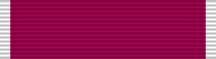
Legion of Merit
DecorationLOM
For exceptionally meritorious conduct in the performance of outstanding services.
Check your eligibility and build your ribbon rackHow you get it
A decoration must be officially awarded. Meeting the standard isn't enough: someone has to recommend you and the approval authority has to sign off. The citation and special order are your proof.
Approval: Approved at the level set in DAFMAN 36-2806, Military Awards: Criteria and Procedures.
It belongs on your record if
- You received it: a citation and special order were issued to you, or it's on your DD-214 or personnel record
- It was approved, but it's missing from your DD-214 or personnel record
What it's awarded for
- Distinguished yourself by exceptionally meritorious conduct in the performance of outstanding services (combat or noncombat) since Sept. 8, 1939
Devices
- Combat "C" device: Your citation or special order shows the award included the C (awarded for service or achievement under combat conditions while personally exposed to hostile action on or after Jan. 7, 2016)
- Remote "R" device: Your citation or special order shows the award included the R (awarded for hands-on weapon-system employment with direct, immediate impact on a combat operation, without exposure to hostile action; RPA, cyber, space, or ISR fields, on or after Jan. 7, 2016)
Quick facts
- Category
- Personal decorations
- Type
- Decoration
- Authorized devices
- Oak Leaf Cluster, Combat “C” and Remote “R” Devices
- WAPS points
- 7
- Position in the AFPC listing
- 7 of 91 (listed in order of precedence)
Full AFPC fact sheet text
Background
The Legion of Merit, the first United States decoration created specifically for citizens of other nations, was established by an Act of Congress of July 20, 1942, and amended by an executive order on March 15, 1955.
Criteria
It is conferred on officers and enlisted members of the armed forces of the United States and on nationals of other countries who have distinguished themselves by exceptionally meritorious conduct in the performance of outstanding services since Sept. 8, 1939, the date of the president's proclamation of the state of emergency that led to World War II. The Legion of Merit may be awarded for combat or noncombat services; in the case of American military personnel, if the award is for combat service it is shown by the wearing of a combat V device.
Medal description
The Legion of Merit is also the first award to have different degrees. If a holder of the Legion of Merit in one degree is subsequently given another such award, it is never in a degree lower than the original one. The degrees of chief commander and commander are conferred on members of foreign governments only and are awarded for services comparable to those for which the Distinguished Service Medal is given to members of the United States armed forces.
Authorized devices
Oak Leaf Cluster, Combat “C” and Remote “R” Devices
Eligibility criteria for combat “c” device
The "C" device was established to distinguish an award earned for exceptionally meritorious service or achievement performed under combat conditions on or after Jan. 7, 2016 (this is not retroactive prior to this date).
The device is only authorized if the service or achievement was performed while the service member was personally exposed to hostile action or under significant risk of hostile action:
- While engaged in action against an enemy of the United States
- While engaged in military operations involving conflict with an opposing foreign force; or
- While serving with friendly foreign forces engaged in an armed conflict against an opposing armed force in which the United States is not a belligerent party
The use of the "C" device is determined solely on the specific circumstances under which the service or achievement was performed. The award is not determined by geographic location. The fact the service was performed in a combat zone, a combat zone tax exclusion area, or an area designated for imminent danger pay, hardship duty pay, or hostile fire pay is not sufficient to qualify for the "C" device. The service member must have been personally exposed to hostile action or under significant risk of hostile action.
Rank/Grade will not be a factor in determining whether the "C" device is warranted, nor will any quotas, official or unofficial, be established limiting the number of "C" devices authorized for a given combat engagement, a given operation, or cumulatively within a given expanse of area or time.
Eligibility criteria for remote “r” device
The "R" device was established to distinguish an award earned for direct hands-on employment of a weapon system that had a direct and immediate impact on a combat operation or other military operation (i.e. outcome of an engagement or specific effects on a target). Other military operations include Title 10, United States Code, support of non-Title 10 operations, and operations authorized by an approved execute order.
The action must have been performed through any domain and in circumstances that did not expose the individual to personal hostile action, or place him or her at significant risk of personal exposure to hostile action:
- While engaged in military operations against an enemy of the United States; or
- While engaged in military operations involving conflict against an opposing foreign force; or
- While serving with friendly foreign forces engaged in military operations with an opposing armed force in which the United States is not a belligerent party
Qualifying Career Fields
The "R" device may be awarded to Airmen who, during the period of the act, served in the remotely piloted aircraft; cyber; space; or Intelligence, Surveillance, and Reconnaissance career fields on or after Jan. 7, 2016 (this is not retroactive prior to this date).
Basis for a Decoration
- The "R" device is only authorized for a specific achievement (i.e. impact awards) and will not be authorized for sustained performance or service (i.e. end-of-tour, separation or retirement decorations)
- Recognition for direct and immediate impact shall be based on the merit of the individual's actions, the basic criteria of the decoration, and the "R" device criteria
- Performance of a normal duty or accumulation of minor acts will not justify the "R" device. The act must have been: performed in a manner significantly above that normally expected and sufficient to distinguish the individual above members performing similar acts
- A decoration should only be recommended in cases where the event clearly merits special recognition of the action (i.e. achieving a strategic objective or saving of lives on the ground)
Source: Legion of Merit fact sheet, Air Force's Personnel Center
 Medal of Honor
 Air Force Cross
 Defense Distinguished Service Medal
 Distinguished Service Medal
 Silver Star Medal
 Defense Superior Service Medal
 Distinguished Flying Cross
 Airman's Medal